
Have you read Don’t Betray Me and would you like to read more about Amsterdam and the Netherlands during the Second World War? These are some interesting sites and books:
Amsterdam.nl (Amsterdam City Archives) – The real story of Abram Agsteribbe, which is summarized in this book. It also includes a picture of Abram.
Amsterdamopdekaart.nl – Descriptions of more than 4.000 buildings that show the development and cultural history of Amsterdam.
Annefrank.org – Lots of background information on World War II, and especially on Anne Frank, who recorded her experiences as a girl in hiding in her famous diary.
‘De vroege herdenking van de Jodenvervolging in Amsterdam vanaf 1945 tot en met 1965‘ – (2014). MA-thesis of Antonie Golverdingen, Leiden University. A well-documented thesis about the early monuments and lack thereof just after the war. The monument made for Felice and her family at the end of the story is an imaginary one. However, the Auschwitz monument was erected on that location, in Wertheim Park, in 1993.
‘De Zure Stad‘ – (2022, 15 11). Paul van Ravestein en Monique Mulder. ISBN 9789038810355 – A wonderful book on the history of pickling plants and vinegar sellers in Amsterdam.
Een Eeuw Amsterdam – Video series covering ‘A Century of Amsterdam’ on the YouTube channel of Tim Weissenberger.
Geschiedenismagazine.nl – Captured on film – Reich Commissionar Seyss-Inquart’s speech on 19 May 1943 in the Stork factory hall in Hengelo, as referred to in Chapter 2.
Historiek.net – Website about various historical topics, written by Enne Koops (1978-2023) and Dr. Jan Brouwer, among others.
Holocaust-lestweforget.com – A memorial website for the Dutch Jewish people who perished during World War II.
Joodsamsterdam.nl – Here you can find everything about Jewish families who lived in Amsterdam before the Second World War, about the Jewish schools, the pickling plants, and the Jewish Council.
Joodsmonument.nl – A memorial to the more than 104.000 people who were persecuted in the Netherlands, and did not survive the Shoah (Holocaust)15, including the Agsteribbe
family.
Kampwesterbork.nl – Website of the Camp Westerbork Memorial Centre that is located on the site of the transit camp from which 107,000 Jews, Roma, and Sinti people were deported to death camps in Eastern Europe.
Mijngelderland.nl – Website with stories about the capitulation and negotiations in Wageningen, in the Dutch province of Gelderland.
Oblivionsoave.wordpress.com – Here you can read the story of the English bomber that crashed into the houses in Van Bossestraat (3 May 1943). Apart from three New Zealand airmen, seven civilians were killed.
Onsamsterdam.nl – Website with a lot of information about the Jewish Quarter.
Oorlogsmuseum.nl – Overloon War Museum: Dutch National War and Resistance Museum Foundation: the largest war museum in the Netherlands and the oldest World War II museum in Western Europe, with a D-Day experience and a military hall with more than 180 vehicles, boats and aircraft.
Verzetsmuseum.org – Elaborate website with a section ‘WW2 in stories’ with files about a wide range of topics on the website of the Amsterdam Resistance Museum.
Witteolifant.nl – Website of public school The White Elephant that pays tribute to its war history.
Yadvashem.org – Yad Vashem, The World Holocaust Remembrance Center. If Peter’s story had been a real one, he would have been accepted into the list of the ‘Righteous Among the Nations’, people who did the right thing during the Second World War, even if they were not Jewish, and their own lives were in danger.
The author and publisher have taken the utmost care to represent the facts and sources used in this book accurately. Nevertheless, errors may have inadvertently crept in. Please contact us if this is the case. This is, however, first and foremost a work of fiction.
THANK YOU
This book would not have been written if my father, Henk, had not meticulously written down and told me his memories of his childhood during the war. My great thanks and infinite love, therefore, go to you, Dad!
My mother, Ria, also contributed greatly, as her additions about her childhood near the Philips factory buildings in Eindhoven also provided details for this book. I love you dearly, Mum!
I am so glad that I was able to write down this story and that you are both happy with the result.
I am very lucky to have found Cecile Reijnders. She did the beautiful, apt drawings for ‘Don’t Betray Me’, including the one of Mouse, modelled after my dear bonus daughter Annelotte’s cuddly toy. Thank you, Cecile, I really appreciate your involvement and creativity! You have brought my story to life.
The cover and book design were not the only results of my highly valued collaboration with Dafne Arlman. Her expertise in self-publishing helped me to take big steps in the right direction.
Cora van Santen of Schrijverspunt supported me tirelessly in the process as well, with her encyclopaedic knowledge. Thank you both!
I am also grateful for the tips that Lily Koomen gave me. She was an editor at Kluitman Publishers for years and gave me invaluable tips on how to bring the story to life. She expressed her wish that this book would come to fruition.
I also thank my friend Francisca van der Steen for her writing workshops and the valuable feedback that motivated me to keep writing.
Furthermore, thank you to all the co-readers, including my dearest Harry Vonk, my sister Liesbeth – who showed an unknown passion for public relations, my lovely niece Wendy with her honest feedback, my friend Yvonne Brok with her relentless pep-talks and supportive advice, and my second mother Dinie Kiekens, who also endured hardship, and always supports me.
A big thank you to Alon Ben Joseph, Salomon Pierre Jean Dingsdag, and Daniel Kuperard, who gave me valuable tips from a Jewish perspective, and Jurgen Wagenaar (14 years old), who was the first teenager to read the story: you gave me the confidence to publish this book.
The loving editorial work of my friend Marjanne Reijne, who had the thankless task of proofreading my Dutch manuscript, made the book complete – and better!
A big thank you to my friend abroad, Kerrin Webb, for patiently working on the English translation and moulding my words into a real story that will hopefully touch the hearts of many.
Special thanks to everyone at the Jewish Cultural Quarter (JCK) and the Amsterdam City Archives, who – even without me asking – searched for more information about the Oudeschans and its inhabitants.
And thank you to all my sponsors at Voordekunst.nl for your support. Some have turned out to be true reading ambassadors! Without your contribution, I would not have succeeded in spreading the word about ‘Don’t Betray Me’ so widely. Let’s hope that young people will rediscover how much fun reading is, even when you touch on the heavy but important topics.
And lastly, but most important of all: you, the reader of this book. I hope that you keep reading – and keep dreaming, broadening your horizons, and expanding your knowledge. Don’t believe everything
that is claimed by those with the loudest voices. Investigate, use your creativity, and stay curious. Unexpected things will cross your path. New people. Help them. I’ve found that when you have a purpose in life that goes beyond your own needs, you feel truly happy.
Love & Light
Melinda
GLOSSARY
- Arthur Seyss-Inquart was an Austrian Nazi official who was in charge of the Netherlands during the occupation in World War II. The Dutch people mockingly called him ‘Mr Six-and-Quarter’ (‘Zesenkwart’ in Dutch). For phonetic resemblance, ‘Mr Sassy Quarter’ was used in this book.
- Führer – German for leader, the name that was used for Adolf Hitler.
- Bat mitzvah – When a Jewish girl reaches the age of twelve, she becomes responsible for observing the Jewish commandments (mitzvot). At that point, she becomes a bat mitzvah.
- Aba – Hebrew word for Father.
- Ima – Hebrew word for Mother.
- Mezuzah – On the doorposts of Jewish homes and rooms hangs a small, rectangular box at an angle. Inside is a tiny scroll with two handwritten passages from the Torah—the holy book of the Jewish people.
- Adonai – My Lord, derived from Hebrew, and used to avoid the holy name of God, Yahweh.
- Oy vey! – Oh, woe! A Yiddish expression to express dismay.
- Mokum – slang for City of Amsterdam (Mokum Alef), word derived from Hebrew.
- Peddle – Sell, often from door-to-door.
- Dyno torch – A mechanically operated flashlight which you have to squeeze to turn on.
- Grüne Polizei – Nazi police officers who, because of their green uniforms, were called the Green Police.
- Kippah – Traditional headwear worn by Jewish men.
- Star of David – The Star or Shield of David, known in Hebrew as magen David, is a positive and spiritual symbol of Judaism, shaped as a six-pointed star. During the Second World War, this symbol—the ‘Jewish star’—was misused by the Nazis to mark Jews as distinct from the rest of the population. This made it easier to identify, arrest, deport, and ultimately murder them.
- Shoah / Holocaust – During the Second World War, the Nazis killed almost six million European Jews. This genocide is called Shoah (Hebrew) or Holocaust (English).
ABOUT THE AUTHOR
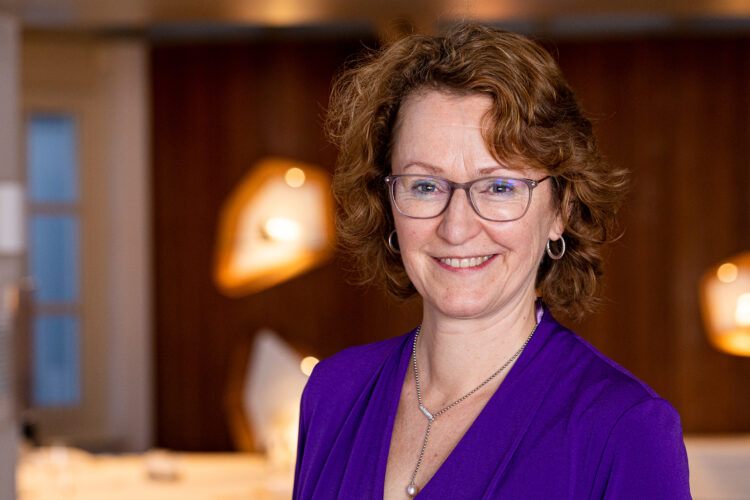
Melinda Braaksma (Amsterdam, 1968) became fascinated by her father Henk Braaksma’s childhood stories about World War II. He was an ordinary boy who moved to a house in Amsterdam’s Jewish Quarter when he was six years old in 1943. The house had been the home of several Jewish families before they were deported.
This fact is the basis for the fictional story ‘Don’t Betray Me’, which has the common thread of: ‘What if …?’ What if a Jewish girl had stayed behind in the house?
With her years of experience as a copywriter and teacher, Melinda has turned the story into an exciting children’s book, with realistic and sometimes unbelievable real-life details about everyday life during World War II. The hope for a peaceful society without prejudice can be read between the lines.
Melinda’s great wish is for the book to be read in classes all over the Netherlands as the country celebrates more than 80 years of liberation. On www.MelVertel.nl, she wants to contribute to the promotion of reading among Dutch youth.